

If you're responsible for implant patients, you already know what you're watching for during maintenance. Probing depths, bleeding, suppuration, tissue changes, radiographic bone levels and other clinical findings all help you determine what's happening around an implant.
What interests me is whether we're getting better at seeing another layer of the picture. Can biological information help identify changes in the peri-implant environment before those changes become an obvious clinical problem?
After my own implant failures, that's a question I've become increasingly interested in.
CLINICAL SIGNS TELL YOU WHAT'S HAPPENING. CAN BIOMARKERS TELL YOU MORE?
Peri-implant disease doesn't suddenly appear the morning it becomes clinically obvious. Changes in microbial communities, host inflammatory response and tissue breakdown are biological processes that develop over time.
That's why there's growing interest in looking beyond clinical findings alone and examining what may be happening at the molecular and microbial level.
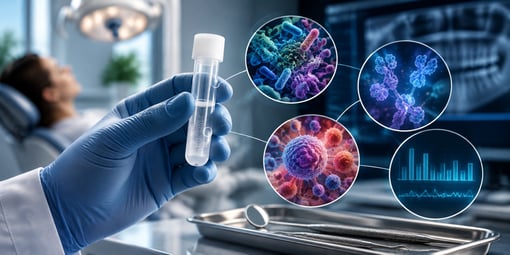
One example is active matrix metalloproteinase-8 (aMMP-8), an enzyme associated with collagen breakdown and periodontal and peri-implant inflammation. Researchers have been evaluating chairside aMMP-8 testing as a potential adjunct for identifying active tissue destruction and monitoring changes in peri-implant health.
Salivary and peri-implant biomarkers are also being investigated more broadly, along with microbial testing designed to characterize shifts in the bacterial environment.
None of these eliminates the need for a clinical examination. The more interesting possibility is whether they can provide additional information that helps refine risk assessment or identify biological change earlier.
THEN THERE'S THE MICROBIOME
Biofilm is obviously not a new subject in dentistry. What continues to evolve is our understanding of the relationship between the microbial community and the host response.
The issue isn't simply whether bacteria are present. It's the interaction between microbial dysbiosis, inflammation, the patient's susceptibility and the peri-implant environment that becomes particularly interesting.
That raises a more useful question than simply, “Is there plaque?”
Is this biological environment moving toward health or away from it?
And if there are ways to recognize that shift sooner, does that create an opportunity to intervene before significantly more damage occurs?
MORE DATA ISN'T AUTOMATICALLY BETTER DATA
This is where I think skepticism is healthy.
A new test isn't clinically useful simply because it produces a number. A biomarker may be biologically interesting without yet being sufficiently validated to change treatment decisions, and an association with disease doesn't automatically make something a reliable predictor of future implant failure.
The real standard should be tougher: Does this information tell you something clinically meaningful that you didn't already know, and can you do something useful with it?
That's the conversation I want to hear.
TEST. TEACH. TREAT. REPEAT.
Dr. Thomas Larkin has built his approach around that idea. His implant-maintenance protocol incorporates biological testing and monitoring alongside patient education and treatment, with the goal of identifying biological risk before clinical breakdown occurs.
He's going to walk through that approach at Biology in Dentistry, the free live virtual Dental Summit I'm hosting on Thursday, October 29. We'll look at salivary diagnostics, phase-contrast microscopy, inflammatory biomarkers, microbiome health and biologically oriented maintenance and, importantly, where these tools may fit alongside the clinical information you already use.
If you place, restore or maintain implants, I think the question is worth exploring: What could you know about the biological environment before the implant is obviously in trouble?
To your unstoppable success,

President
eLaunchers.Com