

Here's something I've learned while digging into implant biology that initially sounded almost contradictory.
We know excessive micromotion can interfere with osseointegration. Yet researchers are also investigating whether the right kind of controlled mechanical stimulation might actually support some of the biological processes involved in bone formation and healing.
The difference, of course, is in the type, magnitude, frequency and timing of that mechanical input. And that's where the science of mechanobiology gets interesting.
BONE IS CONSTANTLY RESPONDING TO ITS ENVIRONMENT
Bone isn't a static structural material. It's living tissue that continually adapts to the mechanical environment around it through coordinated cellular signaling and remodeling.
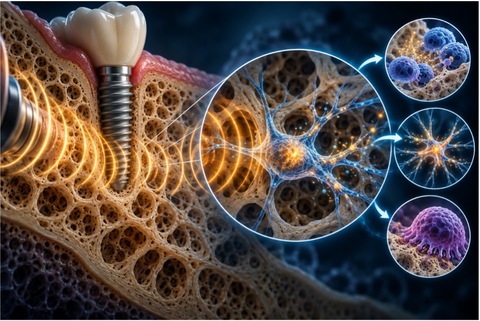
Osteocytes play an important role as mechanosensors, detecting mechanical changes and helping regulate the activity of osteoblasts and osteoclasts. Through a process known as mechanotransduction, mechanical stimuli can be converted into biochemical signals that influence how bone is formed, maintained and remodeled.
None of that is new to dentistry. What is newer is the question of whether we can deliberately apply certain forms of mechanical stimulation to influence that biology in a useful way.
NOT ALL MOVEMENT IS THE SAME
This distinction is important.
When dentists think about movement during early implant healing, the concern is understandably excessive micromotion at the bone-implant interface. Too much movement can disrupt the development of stable osseointegration.
Low-magnitude, high-frequency vibration is a very different proposition.
Rather than destabilizing the implant, LMHFV uses small mechanical signals delivered at relatively high frequencies. Researchers have been studying whether those signals can influence cellular activity, bone remodeling, angiogenesis and other processes involved in musculoskeletal and oral healing.
That doesn't mean vibration automatically produces better osseointegration. It means there's a biological mechanism interesting enough to investigate.
THE IMPORTANT QUESTION IS WHAT THE EVIDENCE ACTUALLY SHOWS
This is where I think dentists are right to be demanding.
An interesting mechanism isn't enough. Animal data isn't the same thing as human clinical evidence, and an improvement in a surrogate marker doesn't automatically translate into a meaningful improvement in implant survival.
The questions that matter are much more practical. What magnitude and frequency should be used? When should stimulation begin? How long should it continue? Which patients might benefit? Are there circumstances in which it shouldn't be used?
And ultimately, does it produce a clinically meaningful difference?
Those are exactly the kinds of questions I want asked whenever a new technology enters dentistry.
THIS IS WHERE ALVEO5 BECOMES INTERESTING
Dr. Christopher Phelps is going to examine the science of low-magnitude, high-frequency vibration at Biology in Dentistry, the free live virtual Dental Summit I'm hosting on Thursday, October 29.
He'll look at the proposed biological mechanisms, the preclinical and clinical evidence, and the practical limitations that still need to be considered. He'll also share early clinical experience using Alveo5, a high-frequency vibration device designed around this concept, with ceramic implant patients.
I'm interested in Alveo5 for the same reason I'm interested in the other subjects we're exploring. If there's a way to influence the biological environment after you've done the excellent clinical work, I want to understand the science behind it.
If you do too, join us on October 29.
To your unstoppable success,

President
eLaunchers.Com