


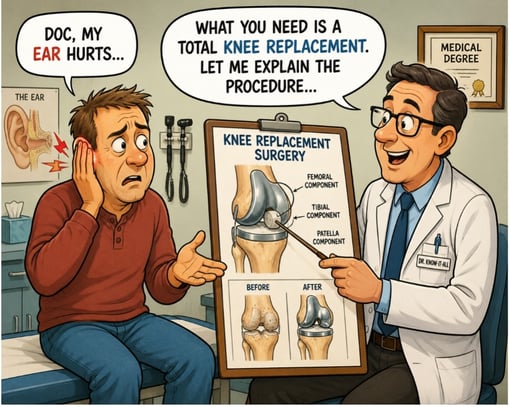
Imagine walking into a doctor’s office, sitting down in the examination room, and having the doctor immediately launch into a ten-minute explanation of knee replacement surgery.
He doesn’t ask what brought you in, where it hurts, how long it has been bothering you, or whether you have tried anything already. He simply starts explaining the procedure in impressive detail.
There is just one small problem: your knee feels fantastic because you came in with an earache.
Obviously, that would be ridiculous. Before recommending treatment, a good doctor needs to understand the patient and where they are right now.
Yet businesses do essentially the same thing every day.
They create one advertisement, landing page, sales presentation, or email campaign and deliver the same message to everyone, regardless of what those people already know, believe, or how close they are to making a decision.
Legendary copywriter Eugene Schwartz understood this problem decades ago. Before you can persuade someone, you need to understand where the conversation is starting.
Your Customers Are Not All Standing in the Same Place
In his classic book Breakthrough Advertising, Schwartz described different stages of customer awareness. Some people don’t know they have a problem yet, while others know the problem but have no idea what solutions exist. Some are researching solutions, some already know about your company, and others are practically standing at the cash register waiting for a reason to buy.
Those people should not receive the same message.
Imagine you offer a service that helps business owners prepare their companies for an eventual sale. One owner may be 42 and completely focused on growth, while another is 58 and beginning to think seriously about retirement. A third may have just received a disappointing business valuation, while a fourth already has an interested buyer.
It is the same service, but those are four completely different conversations.
Tell the 42-year-old, “Schedule your business valuation today,” and she may keep scrolling because you are solving a problem she does not believe she has.
Tell the owner who just received a disappointing valuation, “The decisions you make in the next 12 months could dramatically change what someone is willing to pay for the company you spent 25 years building,” and suddenly you have attention.
You did not become more persuasive. You became more relevant.
Sometimes the Customer Needs to Recognize the Problem
At the earliest stage of awareness, a prospect may be experiencing symptoms without understanding the underlying problem.
A business owner knows revenue has flattened but blames the economy. A homeowner notices a small stain on the ceiling but assumes it is nothing serious. A dental patient avoids certain foods without realizing a worsening bite may be contributing to the discomfort.
An immediate sales pitch is unlikely to work because, from their perspective, you are selling a solution to a problem they have not agreed exists.
At this stage, good marketing helps people recognize themselves. A story, question, example, or explanation can help the prospect make the connection and think, “Wait a minute. I do that.”
That realization moves the conversation forward.
Other Customers Are Already Looking for an Answer
Now consider someone who knows exactly what is wrong. The roof is leaking, the tooth hurts, sales are down, retirement is approaching, or the website gets traffic but generates almost no leads.
These prospects do not need another long explanation of why the problem matters. They want to know what they can do about it.
This is where education, comparisons, reports, case studies, and other useful information become powerful. You can help prospects understand their options, avoid mistakes, evaluate solutions, and determine what separates one approach from another.
Move further along the journey and the questions change again. A prospect who already knows your company may be asking why they should choose you, whether they can trust you, what the process involves, and what happens if they make the wrong decision.
At that point, proof, testimonials, guarantees, case studies, strong offers, and clear calls to action become increasingly important because the prospect does not need another lecture about the problem. They need confidence in the decision.
Great Marketing Can Still Arrive at the Wrong Time
This helps explain why genuinely good marketing sometimes underperforms.
The copy may be strong, the offer legitimate, and the design beautiful, but the message may simply be arriving at the wrong point in the customer’s journey.
If I walk up to you at a party and ask you to marry me before introducing myself, the problem probably isn’t that my proposal lacked persuasive language. We skipped a few important steps.
Marketing relationships work much the same way. A cold prospect may need education before an offer, while someone comparing solutions may need proof. Someone who already knows you and wants what you sell may simply need a compelling reason to act now.
Good marketing does not try to drag someone from complete indifference to a purchase in one heroic leap. It understands where people are and helps them take the next reasonable step.
Before You Ask What to Say, Ask Where They Are
Eugene Schwartz published Breakthrough Advertising in 1966, long before websites, email campaigns, search advertising, retargeting, or marketing automation.
Today, we have more opportunities than ever to communicate with customers at different points in their journey, but the strategic question underneath all that technology remains remarkably simple:
What does this person already know, and what do they need to understand next?
Answer that question before you start writing, and your marketing begins to feel less like a sales pitch and more like a useful conversation. Ignore it, and you may find yourself enthusiastically explaining knee replacement surgery to someone who came in with an earache.
If your marketing is generating attention but not enough action, visit www.meetparthiv.com to schedule a complimentary Strategic Growth Session. We’ll look at your market, your message, and the journey prospects take before becoming customers to identify where the conversation may be breaking down.
Great marketing is not simply about knowing what to say. It is about understanding when your customer is ready to hear it.
To your unstoppable success,

President
eLaunchers.Com