


Let’s imagine I hire you to build me a vending machine.
I give you a generous budget, plenty of time, and complete creative freedom. When you finally unveil it, I’m impressed. The machine is beautiful, the display is gorgeous, the lighting is perfect, and the entire thing looks like it belongs in the lobby of a five-star hotel.
There is just one problem. There are no buttons.
People can admire the machine. They can stand in front of it, take pictures of it, tell their friends about it, and compliment whoever designed it. They just can’t buy anything.
I would probably have a few questions.
Legendary direct-response marketer Dan Kennedy has spent much of his career asking businesses essentially the same question about their marketing.
It looks nice, but what exactly is it supposed to make someone do?
That question sounds almost embarrassingly simple, yet it exposes one of the most common problems in marketing. Businesses become so focused on getting attention that they forget what they wanted to happen after they got it.
Marketing Is Not a Decorating Contest
There is nothing wrong with beautiful marketing. I like attractive websites, well-designed advertisements, clever campaigns, and great branding as much as anyone else.
I just don’t confuse any of those things with the objective. The objective is response.
Dan Kennedy became one of the most influential voices in direct-response marketing because he was relentless about this distinction. Marketing should not simply exist. It should give the prospect a reason to take a specific, measurable action.
That action might be making a purchase, scheduling an appointment, requesting information, registering for an event, calling a phone number, downloading a report, or taking another step that moves the relationship forward.
Whatever the action is, the marketer should know what it is before the campaign begins. That sounds obvious until you look at how much marketing ends without ever clearly asking for anything.
Visit a few business websites and you will find pages filled with mission statements, company histories, beautiful photographs, vague promises, and paragraphs explaining how passionate everyone is about providing exceptional service.
Then you reach the bottom of the page and wonder what you are supposed to do next.
The vending machine looks fantastic. We still forgot the buttons.
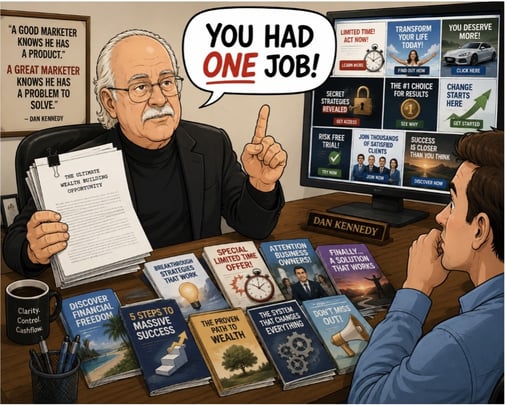
Every Piece of Marketing Needs a Job
One of the most useful habits I learned from studying direct response is to ask a very simple question before creating any piece of marketing: What do I want this person to do next?
Not eventually or after they have wandered around the website for twenty minutes and achieved enlightenment.
What is the next reasonable action?
If I send an email, perhaps I want you to click through to a landing page. If you arrive at that landing page, perhaps I want you to request a report. Once you request the report, perhaps I want you to schedule a conversation.
Each piece has a job, and each response moves the prospect one step further.
The mistake happens when businesses expect every piece of marketing to do everything at once. The email needs to educate, establish credibility, tell the company story, introduce seven services, explain the process, overcome every possible objection, and somehow close the sale before the reader finishes their coffee.
That usually produces a lot of words and very little movement.
Good direct marketing is much more disciplined. It knows what job each piece needs to accomplish and gives the prospect a clear reason to take that next step.
Attention Is Valuable Only If You Do Something With It
Modern marketing gives us more ways to measure attention than Kennedy could have imagined during much of his career.
We can count views, impressions, clicks, likes, shares, comments, followers, visitors, watch time, open rates, and dozens of other numbers.
Some of those metrics are extremely useful, but they can also become wonderfully distracting.
Imagine telling your sales manager that the company generated no sales this month, but the good news is that 14,000 people really enjoyed the brochure. I suspect the celebration would be brief.
Attention matters because response cannot happen without it, but attention itself is not necessarily the finish line.
A video with 100,000 views may be valuable. A social post shared thousands of times may be valuable. A website attracting enormous traffic may be incredibly valuable.
The question is what happens next.
If 20,000 people visit your website and nobody contacts you, you do not necessarily need more traffic. You may need to figure out why all those people are leaving.
If thousands of people open your emails but very few click, the subject line may be doing its job while the rest of the email is not.
If your social media audience grows every month but the business cannot connect that attention to meaningful opportunities, you may have built an audience without building a path.
Direct response forces us to keep asking the uncomfortable question:
What did the marketing produce?
Give People a Reason to Respond
Of course, putting a giant “BUY NOW” button on everything is not a marketing strategy.
People need a reason to act. And this is where the offer becomes so important. A call to action tells someone what to do. An offer gives them a reason to do it.
There is an enormous difference.
“Contact us today” is technically a call to action, but it does not answer the prospect’s most obvious question: Why?
- Why should I contact you today instead of next month?
- Why should I download this report?
- Why should I schedule this consultation?
- Why should I give you my email address?
- Why should I take five minutes out of an already busy day to do anything you are asking me to do?
Good direct marketing respects that question.
Maybe the prospect receives valuable information. Maybe there is a deadline. Maybe availability is limited. Maybe the consultation helps identify a costly problem. Maybe the report answers a question the prospect is already trying to solve.
The reason does not have to involve a discount, and it certainly does not have to involve fake urgency or a countdown clock that mysteriously resets every time you refresh the page.
It simply has to matter to the person you are asking to respond.
Measure the Response You Actually Want
Kennedy’s direct-response philosophy also forces businesses to confront another uncomfortable reality: if you cannot tell whether your marketing caused anything to happen, it becomes very difficult to improve it.
Suppose you spend $10,000 on a campaign and sales increase the following month. Wonderful.
Was it the campaign?
Maybe.
Was it seasonality, referrals, an existing customer placing a large order, or your salesperson finally calling back the 37 leads sitting in the CRM?
Also maybe.
This is why direct marketers have always cared so much about trackable response. Unique phone numbers, response codes, coupons, reply cards, dedicated landing pages, tracking links, and other mechanisms may have changed over the years, but the principle remains the same.
Connect the message to the action whenever possible. Once you can do that, marketing stops being quite so mysterious.
You can see which headline generated more response, which offer attracted better prospects, which email produced appointments, which advertisement brought in customers, and which campaign everyone loved but nobody acted on.
That last one hurts a little. It is also incredibly useful.
Sometimes the Market Will Hurt Your Feelings
One of the reasons I love direct-response marketing is that it can be wonderfully humbling.
You can spend three weeks developing the campaign everyone thinks is brilliant, launch it with tremendous confidence, and watch absolutely nothing happen.
Then you can test the headline somebody scribbled on a legal pad during lunch, and it wins by 40 percent.
The market has no interest in protecting our feelings. And that’s a good thing.
When response becomes the standard, we stop arguing quite so much about which version everyone personally likes. We can put ideas in front of real prospects and allow their behavior to teach us something.
Sometimes they confirm what we believed. Sometimes they surprise us. Either way, we learn.
That is much more useful than sitting around a conference table debating whether the blue button feels more “on brand.”
Direct Response Does Not Mean Screaming at People
There is also a misconception that direct-response marketing has to be aggressive.
It doesn’t.
You do not need seventeen exclamation points, flashing arrows, manufactured scarcity, or a man shouting into a camera about an opportunity that disappears at midnight.
Direct response simply means the marketing is designed to produce and measure a response.
That response can begin with education. It can begin with a useful report, an invitation, a consultation, a demonstration, or another low-pressure next step.
In fact, the best response is often not “Buy this right now.”
It is simply, “Let’s continue the conversation.”
That becomes especially important when you sell something expensive, complicated, personal, or difficult to understand. Your prospect may not be ready to buy today, but that does not mean there is no meaningful action they are ready to take.
Your job is to identify it.
Before You Launch Anything, Answer One Question
Marketing has changed enormously since Dan Kennedy began teaching direct response.
We have websites, search engines, social media, marketing automation, streaming video, sophisticated analytics, and technology that allows a small business to reach more people in an afternoon than previous generations could reach in months.
Yet all that technology makes Kennedy’s question more important, not less.
What do you want the prospect to do?
If you cannot answer that clearly, I would not spend another dollar on traffic, another hour rewriting the headline, or another afternoon arguing about the shade of blue on the button.
Figure out the response first.
Then build the marketing backward from there.
Because the prettiest vending machine in the world still has a serious business problem if nobody can buy a candy bar.
If your marketing is getting attention but you are not sure whether that attention is turning into leads, customers, and revenue, visit www.meetparthiv.com and schedule a complimentary Strategic Growth Session.
We’ll look at what you are currently doing, what you want your marketing to produce, and whether there is a clear path connecting the two.
After all, your marketing does not need more admirers.
It needs a job.
To your unstoppable success,

President
eLaunchers.Com