


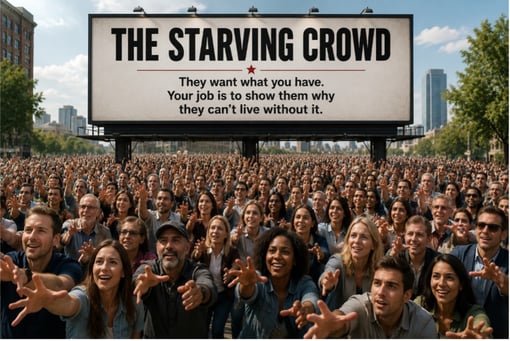
Let me give you a choice.
I’m going to open a hamburger stand, and you get to compete against me. You can choose any advantage you want: better beef, a better location, lower prices, a bigger advertising budget, or the greatest secret sauce ever created. You can even hire a celebrity chef if you’re feeling particularly ambitious.
I’ll take one advantage. I want a starving crowd.
That idea comes from legendary direct-response marketer Gary Halbert, and it may be one of the simplest explanations of great marketing I’ve ever heard. Halbert understood something businesses still manage to forget decades later: before you worry about what you’re going to say, you need to worry about who you’re saying it to and what they already want.
If I put my thoroughly average hamburger stand at the finish line of a marathon filled with hungry runners, and you put your award-winning gourmet burger palace next to a convention full of people who just finished lunch, I like my chances. Your truffle aioli may be spectacular, but it is going to have a difficult time competing with hunger.
Great Marketing Does Not Create Hunger
This is where a lot of businesses get marketing backward. They start with themselves, their product, their service, their website, their campaign, or whatever they happen to be excited about selling, and then they immediately begin asking how to get people interested.
That often leads to the question every marketer eventually hears: “How do we get people to want this?” Sometimes that is the wrong question entirely.
A much better question is, “Who already wants the result this provides?”
That small shift can completely change a campaign because you are no longer trying to manufacture desire where very little exists. Instead, you are identifying the people who already have a problem, want a result, or feel enough frustration that they are actively looking for a better answer.
Imagine you sell a sophisticated financial planning service. You could advertise it broadly to everyone with money and spend an enormous amount of time explaining why financial planning matters, or you could identify people who just sold a business, received an inheritance, are approaching retirement, or suddenly find themselves responsible for financial decisions they do not feel prepared to make.
It is the same service, but the level of hunger is completely different. One audience needs to be convinced that they should care, while the other is lying awake at 2:17 in the morning thinking, “I really need to figure out what I’m going to do with this money.”
Which person would you rather talk to?
Gary Halbert would probably point toward the second group and wonder why we were still debating it.
This Is Where Good Copy Actually Begins
People sometimes assume copywriters have a secret collection of magical words hidden in a locked drawer somewhere. We do not.
There is no sentence so persuasive that it can make everyone want everything. Great copy works because it connects something a person already wants with a believable path to getting it, which means the work starts long before anyone sits down to write a headline.
Before I care about the clever opening, I want to know what your customer wants. I want to know what frustrates them, what they have already tried, what they are worried about, what they secretly hope will happen, and what might stop them from saying yes.
Once those things become clear, the copy gets easier because we are no longer guessing at what might matter. More importantly, the copy gets stronger because the message is built around something the prospect already cares about.
Instead of shouting, “LOOK AT OUR AMAZING HAMBURGERS!” to everyone who walks past, we can walk over to the starving crowd and ask a much simpler question:
“Hungry?”
Now we have a conversation.
Your Starving Crowd May Be Smaller Than You Think
This is where Halbert’s lesson becomes particularly valuable for small and midsize businesses. You do not necessarily need millions of people; you need enough of the right people who have the right problem at the right time.
A dentist does not need everyone in town to suddenly become interested in cosmetic dentistry. She needs to find the people who have stopped smiling in photographs because they are embarrassed by their teeth and are finally ready to do something about it.
A roofing company does not need every homeowner to become fascinated by shingles. Believe me, they will not. It needs the homeowner staring at a water stain on the ceiling after last night’s storm and wondering how bad the damage might be.
A business attorney does not need to convince everyone that contracts are fascinating. He needs the business owner who just received an agreement worth $800,000 and suddenly thinks reading the fine print sounds like an excellent use of the afternoon.
The moment matters because urgency changes attention. The problem matters because frustration creates motivation, and the desire matters because people are far more interested in solving their own problems than hearing about our products.
That is your starving crowd.
When you understand exactly who those people are, your marketing stops sounding like an announcement to the general public and starts sounding like a conversation with one person who has a real reason to listen.
Stop Trying to Be Interesting to Everyone
One of the fastest ways to ruin good marketing is to make it appeal to everyone. Someone inevitably says, “We don’t want to exclude anybody,” and I understand the instinct because nobody wants to voluntarily wave goodbye to a potential customer.
The problem is that when you try to speak to everyone, you usually end up speaking directly to no one. The message gets broader, the pain points get softer, the promises become safer, and every sharp edge gets sanded away until you are left with something pleasant, professional, and completely forgettable.
“We provide personalized solutions designed to meet your unique needs.”
Wonderful. So does everyone else on Google.
Now compare that with a message written specifically for the business owner who has not taken a real vacation in seven years because the company cannot function for three days without calling them.
That gives us something meaningful to talk about. We can talk about exhaustion, broken systems, bottlenecks, and the frustration of building a company that supposedly gives you freedom while quietly holding you hostage.
We can tell stories that person recognizes, make promises that person values, and address objections that person actually has. Suddenly, marketing becomes easier because we are no longer trying to entertain an auditorium filled with strangers.
We are having a conversation with someone we understand.
Before You Change Your Marketing, Look at Your Market
I have watched businesses spend enormous amounts of money trying to fix the wrong problem. They redesign the website, change the logo, rewrite the emails, hire another agency, increase the advertising budget, and post more often because apparently the world was desperately waiting for another Tuesday morning LinkedIn post.
Sometimes none of it works, and the obvious conclusion is that the marketing needs another round of changes. But the website may not be terrible, the copy may not be terrible, and the marketing team may not have forgotten some secret trick.
Sometimes the business is simply standing in front of the wrong crowd.
That is when Gary Halbert’s hamburger lesson becomes worth remembering. Before you ask how to make the marketing louder, prettier, smarter, faster, or more sophisticated, ask whether you have found the people with the strongest reason to care.
Who wants the result you provide? Who needs it badly enough to pay attention? Who is already searching for an answer, and who has a problem expensive enough, frustrating enough, painful enough, or important enough that solving it has moved toward the top of the priority list?
Find those people first, and then start writing.
The Best Marketing Often Feels Like Mind Reading
When you get this right, something interesting happens. Prospects begin saying things like, “It’s like you wrote this for me.”
That is one of my favorite things to hear, and not because we are psychic. My crystal ball has been in the shop for years.
It happens because great direct marketing starts with understanding people before trying to persuade them. Gary Halbert understood that, and so did many of the greatest direct marketers I have studied throughout my career.
The tools available to marketers today would have looked like science fiction during Halbert’s career. We can identify audiences, analyze behavior, automate follow-up, test messages, personalize campaigns, and reach thousands of prospects faster than previous generations of marketers could have imagined.
But none of those tools answer the first question for you:
Where is the starving crowd?
Answer that well, and everything that comes afterward becomes easier. Ignore it, and you may spend a fortune trying to sell gourmet hamburgers to people who already ate.
If you would like to take a closer look at your market, your message, and where the biggest opportunities may be hiding in your business, visit www.meetparthiv.com and schedule a complimentary Strategic Growth Session.
We will talk about where you are, where you want to go, and most importantly, who needs to hear from you to help you get there.
Just try not to schedule it over lunch, because all this talk about hamburgers has made me hungry.
To your unstoppable success,

President
eLaunchers.Com