


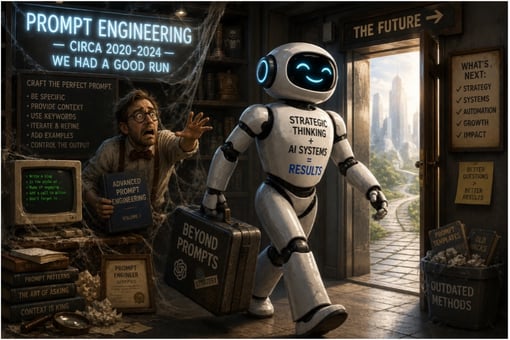
If you've been paying attention to the headlines, you've probably heard that artificial intelligence is coming for marketers, copywriters, consultants, agencies, and just about anyone else who makes a living helping businesses grow.
I don't believe that story. In fact, I think history is about to prove the opposite. AI isn't killing great marketing. It's exposing mediocre marketing.
That's an important distinction because mediocre marketing has been hiding in plain sight for years. It often looks impressive. It comes with beautiful presentations, polished reports, complicated terminology, and plenty of activity. There are meetings about meetings, strategies about strategies, and endless revisions that somehow never produce better results.
Meanwhile, business owners keep writing checks while wondering why growth never seems to match the effort.
That's not a technology problem. That's a value problem.
I've been helping businesses grow for a long time, and one thing has become painfully obvious. Businesses don't hire marketers because they want prettier brochures, clever headlines, or longer email campaigns. They hire marketers because they want more customers, stronger relationships, higher profits, and predictable growth. Everything else is just a tool.
Somewhere along the way, parts of the marketing industry forgot that. Instead of selling results, many started selling activity. More reports became proof of progress. More meetings became evidence of collaboration. More deliverables justified higher invoices. Everyone looked busy, but being busy has never been the same thing as being effective.
Then AI showed up.
Suddenly, tasks that once consumed days can often be completed in hours. Drafts appear almost instantly. Research takes minutes instead of afternoons. Entire campaigns can be organized in a fraction of the time they once required.
Some people looked at those changes and concluded that marketers were in trouble.
I came to a different conclusion.
The marketers who spent years selling time instead of wisdom should absolutely be concerned. The marketers who sell experience, judgment, and strategy have never been more valuable. That's because AI is remarkably good at producing work. It still depends on people to determine what work should be produced in the first place.
Think about the best business advisor you've ever met. Chances are, they weren't valuable because they typed quickly or created beautiful PowerPoint presentations. They were valuable because they asked questions nobody else thought to ask. They spotted opportunities others missed. They challenged assumptions. They helped you avoid expensive mistakes before they happened.
That's not production. That's judgment. And judgment is becoming more valuable, not less.
I've often said that I don't get excited about shiny objects. I get excited about ideas that help businesses grow. Sometimes those ideas involve artificial intelligence. Sometimes they involve changing an offer, simplifying a sales process, or asking one question that completely changes the direction of a campaign. Technology has changed dramatically during my career, but the businesses that consistently succeed still do the same things exceptionally well. They understand their customers, communicate a compelling message, build trust, and execute consistently.
AI hasn't changed those fundamentals. It has simply removed many of the excuses.
Today, average marketers can produce content faster than ever before. Unfortunately, faster average marketing is still average marketing. If your strategy is weak, AI simply helps you execute weak ideas more efficiently. If your positioning is confusing, AI can produce an endless supply of confusing content. If your business doesn't stand out, AI won't magically invent a competitive advantage you never had.
Technology amplifies. It rarely transforms. That's one of the biggest reasons I built my AI-powered campaign platform differently.
I wasn't interested in creating another tool that could write blog posts or generate email copy on command. There are already dozens of excellent tools that can do that. I wanted to create something that helps businesses think better before they ever ask AI to write a single word.
Instead of beginning with content, the platform begins with strategy. It helps clarify your audience, strengthen your positioning, sharpen your offer, organize your messaging, and map an entire customer journey before creating complete campaigns that work together instead of existing as isolated pieces of marketing.
That's the difference between producing content and building a business. One fills a calendar. The other fills a pipeline.
As AI becomes more accessible, every business will have access to extraordinary technology. That means technology itself will no longer separate the winners from everyone else. The businesses that rise above the competition will be the ones that make better decisions, ask better questions, and execute better systems with greater consistency than everyone else.
That's always been the real advantage. AI simply makes it easier to see.
After spending decades helping entrepreneurs grow their businesses, I've become convinced that the future won't belong to the companies with the smartest software.
It will belong to the companies with the smartest strategy. Because here's one lesson I hope you'll remember long after this article is over. AI doesn't reward average businesses. It exposes them.
If you'd like to see how strategic thinking and artificial intelligence can work together to build complete marketing campaigns that create real business growth instead of simply generating more content, I'd love to show you what we've built.
Visit www.meetparthiv.com and let's have a conversation.
To your unstoppable success,

President
eLaunchers.Com