


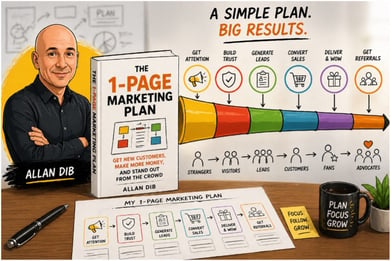
"Marketing is the most important thing in your business… and the least understood." — Allan Dib
That line tends to land pretty hard once you’ve been in business for a while. Because most owners know marketing matters. They feel it when things are slow, and they see it when things are working.
But understanding it… that’s a different story.
Most businesses don’t actually have a marketing plan. They have activity. They run ads, post content, send emails, maybe try a few different things over time. But when you step back and look at it as a whole, there’s no clear structure tying it all together.
And that’s where things start to break down.
What The 1-Page Marketing Plan does really well is simplify something that usually feels overwhelming. It takes what most people think of as a complicated system and breaks it into something you can actually see and understand.
Not theory. Not fluff. Just a clear path from stranger to customer.
And that clarity is what most businesses are missing.
If you look at how most marketing is being done, it’s very reactive. Something isn’t working, so a new tactic gets added. Leads slow down, so a new campaign gets launched. A competitor does something, so it gets copied.
There’s movement, but not direction.
Over time, that creates a patchwork of disconnected efforts. Pieces that might work individually, but don’t support each other in a meaningful way. And when that happens, results become inconsistent.
Dib’s approach is different. It forces you to think in stages. How do people find you? What happens after they find you? How do they move from interest to decision?
And just as important… what happens after they become a customer?
Because that’s where a lot of opportunity is lost.
Most businesses put a lot of effort into getting attention. They focus on generating leads, increasing traffic, and bringing people into the funnel. But once someone becomes a customer, the structure often stops there.
No consistent follow-up.
No clear path for additional value.
No system for turning one transaction into a longer relationship.
That’s a missed opportunity.
A real marketing plan doesn’t stop at the first sale. It extends into retention, referrals, and repeat business. It builds momentum over time instead of starting from zero every month.
That’s how businesses grow without constantly increasing effort.
I’ve worked with companies that were doing a lot of marketing, but couldn’t clearly explain how it all fit together. Once we mapped it out—what was happening at each stage, what was missing, what needed to be improved—the picture became much clearer.
And when the picture is clear, decisions get easier.
You stop chasing random ideas and start improving specific parts of the system.
That’s the real value of this book. It gives you a framework to think with. A way to step back and see your marketing as a whole instead of a collection of separate activities.
And once you can see it, you can start to control it.
Because at the end of the day, that’s what most business owners are looking for. Not more complexity, not more moving parts, but more control. A way to know what’s working, what’s not, and what to do next.
That’s what a real marketing plan provides.
If your marketing feels scattered, inconsistent, or harder than it should be, there’s usually a gap in how the system is structured. Once that structure is in place, things tend to stabilize and improve quickly.
If you want to take a step back and look at your marketing from that perspective, you can schedule a time with me here:
To your unstoppable success,

President
eLaunchers.Com