


Not at some point in the future. This is already happening.
A patient wakes up with a problem. It might be pain, something cosmetic they’ve been putting off, or simply the realization that it’s been too long since their last visit.
They do what people do now. They ask a question.
Sometimes that question goes into ChatGPT. Sometimes it goes into Google’s AI-generated results. Sometimes it goes into tools that most practices are not even paying attention to yet.
What they get back does not look like the search results they used to see. It’s not a list of ten websites, ads, and directories that require time and effort to sort through.
It looks like an answer. It feels like guidance. In many cases, it already points them in a direction.
And in that moment, something important shifts. The patient is no longer searching. They’re beginning to decide.
This Is Where Most Practices Misunderstand What’s Changing
For years, marketing has been built around visibility. The goal was to show up, rank well, run ads, and stay in front of the right people consistently enough to earn attention.
That still matters, but it’s no longer the whole picture.
AI is changing how decisions are made before a patient ever reaches your website. Instead of comparing multiple options and trying to evaluate them on their own, patients are increasingly relying on systems that do that work for them.
Those systems filter information, summarize what matters, and present a smaller set of options that feel more relevant and more trustworthy.
This changes the real question. It’s no longer just whether your practice is visible. It’s whether your practice is being selected as part of the answer.
Those are not the same thing.
What This Looks Like in Real Life
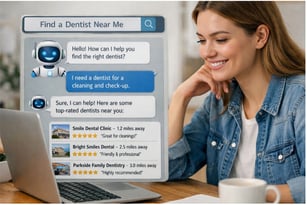
Imagine a patient typing, “Who is the best dentist near me for implants?”
Instead of scrolling through pages of results, they receive a structured response that highlights a few options, along with a short explanation of why those options stand out.
That answer becomes the starting point for their decision.
If your practice is not included in that response, you’re not simply lower on the page. You’re removed from consideration altogether.
There’s no click to compete for and no second chance to be evaluated. And this is where a lot of confusion begins.
Many people assume this shift requires learning new platforms, experimenting with software, or trying to stay ahead of whatever tool is trending at the moment. That’s not what’s driving the change.
The practices that benefit from this shift are the ones that can be clearly understood. AI doesn’t just pull isolated pieces of information. It forms a broader picture based on what it can find and how consistently that information aligns.
It evaluates authority, positioning, clarity, and consistency across multiple sources. Based on that, it determines whether a practice belongs in the answer it provides. And that’s a very different dynamic than traditional search.
The Gap Is Already Forming
Some practices are beginning to show up more frequently in these AI-driven responses.
This is not because they’re louder or spending more money. It’s because what they’ve built is easier to interpret, easier to trust, and easier to recommend.
At the same time, other practices are becoming less visible in ways that are subtle but meaningful.
The schedule may still be full, and nothing may feel dramatically different, but there is a growing reliance on paid channels to maintain that volume. There are fewer organic entry points, fewer mentions, and less presence in the early stages of decision-making.
Most practices haven’t fully recognized this shift yet, but the separation has already started.
This Is Why April 9th Matters
On April 9th, I am co-hosting a session with Dr. Michael Goldberg where we’re going to walk through what this looks like in practical terms.
Dr. Chris Phelps will break down how AI is being used operationally and where it’s creating measurable impact.
Dr. Travis Campbell will connect this to how patients evaluate cost, insurance, and value, especially before they ever speak to the office.
Seth Greene will show what it takes to actually appear in these AI-driven responses when patients are asking questions.
My role is to help connect these pieces so you can see how they fit together, because none of this exists in isolation.
What You Need to Take From This
You do not need to chase every new tool or completely rebuild your marketing approach.
What you do need is a clear understanding of how decisions are being shaped before a patient ever reaches you. Once that becomes clear, the adjustments you need to make are much more straightforward.
Without that clarity, it becomes very easy to fall behind without realizing why.
If you want to see how this is already playing out and where your practice fits into it, join us online April 9th for this live event.
CLICK HERE to claim your spot.
To your unstoppable success,

President
eLaunchers.Com